
Taking a Loan to Buy Bitcoin: The Real Numbers Before You
Thinking about a loan to buy Bitcoin? Understand the real costs, margin call risk, tax rules, and what SEC filings reveal before you borrow a dollar.

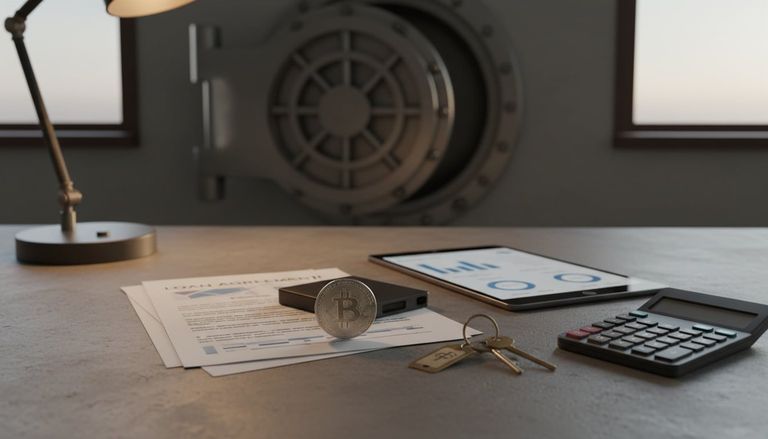
A loan to buy Bitcoin is not one product: it covers two fundamentally different transactions with wildly different risk profiles. You can borrow fiat through an unsecured personal loan or HELOC and use the cash to purchase BTC, or you can pledge existing Bitcoin as collateral for a crypto-backed loan, sometimes to buy more Bitcoin in what amounts to a leverage loop. The first risks your credit score and home. The second risks forced liquidation of your collateral when prices drop. Before you commit a dollar, the numbers from SEC filings, IRS guidance, and actual 2026 market data paint a picture most promotional crypto-lending pages conveniently omit.
What It Actually Means to Borrow Money to Buy Bitcoin
Borrowing money to buy Bitcoin means you are taking on obligation in one currency to acquire an asset denominated in another, and that second currency is among the most volatile in the world. The two structures that exist today carry opposite types of risk.
Neither path is a secret wealth hack. Both put you on a harder timeline than simply buying Bitcoin with cash you already own. The loan clock ticks regardless of what the Bitcoin price does.
There is a third scenario worth acknowledging: using a personal loan or HELOC to buy Bitcoin when you own zero crypto already. This is the purest leverage bet. You owe fixed monthly payments at a fixed or variable rate, and your Bitcoin position has to outperform that cost of capital just to break even. In 2026, unsecured personal loan rates for borrowers with good credit sit in the range of 8% to 18% APR (Federal Reserve data). A HELOC might run you 7% to 10%, but the loan is secured against your house. You are trading real estate risk for Bitcoin exposure.
Crypto-backed loans flip the collateral dynamic. Instead of putting your house or credit score on the line, you pledge Bitcoin you already hold. The lender holds your BTC in custody and issues you dollars or stablecoins. If Bitcoin's price drops far enough, the lender sells your collateral to cover the loan. You never missed a payment: you simply ran out of collateral value.
Personal loan or HELOC to buy Bitcoin: how it works
You walk into a bank or online lender and apply for an unsecured personal loan, or you tap home equity via a HELOC. The lender evaluates your FICO score, income, and debt-to-income ratio. They do not care what you intend to buy with the proceeds. You get cash. You send that cash to an exchange and purchase Bitcoin.
From there, the loan and the asset are completely separate. The lender cannot seize your Bitcoin if you default. They can, however, sue you, garnish wages, or foreclose if it is a HELOC. You owe every dollar regardless of what Bitcoin does. This is the cleanest structure legally, but it puts your entire financial life behind a bet on a volatile asset.
Crypto-backed loan to buy more Bitcoin (leverage loop)
You pledge Bitcoin you already own as collateral and receive dollars or USDC stablecoins. Then you use those proceeds to purchase additional Bitcoin. Now you hold a larger Bitcoin position, but it is encumbered by debt. If the price rises, your gains are magnified. If the price falls, your collateral value shrinks and the lender issues a margin call.
This is effectively trading on margin, but with crypto instead of stocks. According to Investopedia (December 2017), a $100,000 cash loan historically required $200,000 in Bitcoin collateral, implying a 50% loan-to-value (LTV) ratio. Interest rates on these loans ran 12% to 20%. Modern platforms have compressed rates somewhat, but the structural risk remains identical.
Ledn's B2X service, launched in early 2026, explicitly markets this loop: borrow against Bitcoin, buy more Bitcoin with the proceeds. The leverage compounds, and so does the margin call exposure.
How to Get a Bitcoin Loan: The Step-by-Step Reality
Getting a loan to buy Bitcoin is not like applying for a mortgage. The process splits along the same fault line: traditional lenders versus crypto-native platforms. Each path asks different questions and demands different collateral.
For a personal loan or HELOC to buy Bitcoin, you follow the same process as any other loan. You fill out an application. The lender pulls your credit report. You provide pay stubs or tax returns. If approved, funds land in your bank account within a few days to a week. The bank does not know or care that you intend to buy crypto. But if you volunteer that information, some lenders may decline the application: several major US banks have internal policies restricting the use of loan proceeds for cryptocurrency speculation.
For a crypto-backed loan, the process is collateral-first. The platform cares about one thing: the value of the Bitcoin you pledge.
To understand how Bitcoin-backed loans actually function, LTV ratios, custody mechanics, and the distinction between CeFi and DeFi lenders, our guide on how Bitcoin loans work walks through every moving part.
What banks accept Bitcoin as collateral?
Short answer: almost none of them, at least not in the sense of holding your Bitcoin as collateral. Traditional US banks do not custody Bitcoin and do not accept it as collateral for consumer loans. The regulatory framework for bank custody of digital assets remains uncertain. The Office of the Comptroller of the Currency (OCC) has issued guidance allowing national banks to provide crypto custody services, but adoption has been glacial.
What does exist are institutional loans, the kind MicroStrategy uses. MSTR's SEC filing (10-Q, 2026) discloses a loan priced at the Overnight Financing Rate plus 4.24%, maturing in 2026, secured by non-Bitcoin assets. Even the largest corporate Bitcoin holder borrows against traditional collateral, not its BTC stack.
For individual borrowers, the "bank" that takes Bitcoin as collateral is a crypto lending platform: Nexo, Ledn, Figure, or Coinbase. These are not banks in the FDIC-insured sense. They are crypto-finance companies, often registered abroad. Your BTC sits with their custodian, not in a vault with your name on it.
Crypto-native platforms vs. traditional lenders
Par exemple, pour les utilisateurs qui cherchent à s'informer sur les prêts spécifiques à une plateforme, les détails d'un Coinbase Bitcoin Loan sont un excellent point de départ.
Crypto-native platforms evaluate your collateral, not your credit score. Coinbase, through its USDC loan product, allows users to pledge Bitcoin and borrow up to $100,000 in USDC stablecoins (Investopedia, January 2025). No credit check. No pay stubs. The loan-to-value ratio determines how much you can borrow relative to your collateral. A 50% LTV on $100,000 of Bitcoin gets you a $50,000 loan. Drop the LTV to 30% and the same collateral yields only $30,000, but the margin call threshold moves further away.
Traditional lenders ask the opposite questions. They verify income, employment, and credit history. They do not look at your crypto wallet. A personal loan at 12% APR for $50,000 over five years costs roughly $1,112 per month. That payment is fixed whether Bitcoin is at $96,000 or $50,000.
For a ranked look at rates, collateral requirements, and platform custody practices, our review of the best Bitcoin loan platforms in 2026 compares the largest lenders side by side.
Worked Example: Borrowing $50,000 to Buy Bitcoin in 2026
Numbers clarify what emotions obscure. Take a concrete scenario: you borrow $50,000 to buy Bitcoin in 2026, with the asset trading between $77,000 and $96,000 during the year (NerdWallet, February 2026). The outcome depends entirely on which structure you use and when you enter.
Assume a crypto-backed loan at 50% LTV. You pledge $100,000 worth of Bitcoin as collateral (roughly 1.04 to 1.30 BTC at 2026 prices). The lender issues you $50,000 in USDC. You use that USDC to buy an additional 0.52 to 0.65 BTC, depending on the entry price. You now hold roughly 1.56 to 1.95 BTC total, but $50,000 of that position is borrowed money.
The interest accrues monthly. At an illustrative 10% APR (typical for CeFi platforms in 2026), you owe roughly $417 in interest each month. If Bitcoin price stays flat, you lose $5,000 per year to interest costs. If Bitcoin rises, leverage amplifies gains. If it falls, the math turns against you fast.
To run your own numbers for different LTV thresholds and rate assumptions, our Bitcoin loan calculator lets you model multiple scenarios including margin call price levels.
The upside math
Say you enter at $85,000 per BTC. Your $50,000 loan buys 0.588 additional BTC, added to your existing 1.176 BTC collateral. Total position: 1.764 BTC.
If Bitcoin appreciates to $110,000 within the year, your position is worth $194,040. You repay the $50,000 loan plus roughly $5,000 in interest. Net equity: $139,040 on an initial $100,000 of your own Bitcoin. That is a 39% return on your original collateral versus the 29% you would have earned simply holding the 1.176 BTC ($129,360).
The leverage added roughly 10 percentage points of return. Nice, but not life-changing. And you bore liquidation risk every single day to capture it.
The downside math: when a margin call hits
Now start from the same $85,000 entry. Bitcoin drops to $68,000, a 20% decline. Your 1.764 BTC position is now worth $119,952. Your loan is $50,000. Your LTV has climbed from 50% to 41.7%, but measured against collateral, the ratio has actually worsened: your original collateral of 1.176 BTC is only worth $79,968 against a $50,000 loan. That is a 62.5% LTV on the original pledge.
Most platforms issue a margin call when LTV hits 70% to 80%. If Bitcoin drops further to $60,000, your original collateral is worth $70,560 against $50,000 in debt. LTV hits 70.9%, and the lender now has the right to liquidate a portion of your Bitcoin to bring the ratio back under the threshold.
When liquidation happens, it is often at the worst possible moment. The lender sells at market to cover the loan. You get whatever is left. If the price snaps back the next day, you do not participate. Your Bitcoin is gone.
The Margin Call Trap: The Most Costly Mistake Borrowers Make
The most expensive mistake in crypto-backed borrowing is underestimating how fast a liquidation cascade unfolds. Borrowers tend to think of margin calls as a warning email that gives them a few days to add collateral. In practice, when Bitcoin drops 10% to 15% in a single session, automated liquidation engines do not send polite reminders. They sell.
In February 2026, a sharp drop in Bitcoin's price forced the sale of roughly $50 million in loans backing a complex bond deal arranged by Jefferies before the deal even closed (Wall Street Journal, February 2026). The loans were secured by Bitcoin. When the collateral value cratered, the structure forced liquidation. Investors who thought they were buying into a structured credit product ended up holding the bag from a crypto margin call.
The same quarter, Nakamoto Inc. paid down 45 million USDT of its Bitcoin-backed loan to manage collateral pressure (SEC press release, August 2026). This was not a retail borrower: it was a company with treasury management, presumably advised by professionals. Even they got caught needing to deleverage fast.
The takeaway is not that crypto-backed loans are inherently dangerous. It is that the margin call is not a theoretical footnote. It is the central event risk of the product. If you cannot answer the question "at what exact BTC price does my collateral get liquidated," you are not ready to borrow.
Tax Implications: What the IRS Says About Crypto Loans
The IRS has made its position clear on one point and deliberately vague on others. Transactions involving digital assets, including cryptocurrency, must be reported on your tax return (IRS, irs.gov/filing/digital-assets). The tax agency treats Bitcoin as property, not currency.
Receiving loan proceeds is generally not a taxable event: the IRS does not consider borrowed money to be income. This applies whether you borrow dollars from a bank or USDC from a crypto lending platform. The funds are a liability, not a gain.
The tax problem arrives when you repay the loan. If you sell Bitcoin to generate the repayment funds, that sale is a taxable disposition. The difference between your cost basis and the sale price determines your capital gain or loss. Hold for more than one year and you qualify for long-term capital gains rates (0%, 15%, or 20% depending on income). Hold for one year or less and it is taxed as ordinary income.
If the lender liquidates your collateral in a margin call, that is also a taxable event, and you may not have the cash to pay the tax bill. You lost your Bitcoin and you owe the IRS.
⚠️ This is not tax advice. The IRS position on crypto-backed lending continues to evolve. Consult a qualified tax professional before structuring a Bitcoin-collateralized loan.
For more on the tax treatment of crypto collateral and calculating your exposure, our crypto loan calculator guide covers the after-tax math.
Scam Risk and Custody: What the FTC Warns US Borrowers
The FTC's guidance on cryptocurrency scams applies directly to anyone considering a Bitcoin-backed loan. The agency states plainly: only scammers demand payment in cryptocurrency (consumer.ftc.gov). No legitimate lender will ask you to send Bitcoin in advance to secure a loan. Any platform requesting upfront crypto to "verify" your wallet or "unlock" a credit line is a scam.
Custody risk is the less obvious threat. When you pledge Bitcoin as collateral on a centralized lending platform, you transfer your coins to a third-party custodian. You no longer hold the private keys. If the platform is hacked, goes bankrupt, or freezes withdrawals, your Bitcoin is trapped in someone else's balance sheet. The SEC has repeatedly warned about the risks of crypto financial products, noting in its investor guidance that crypto asset custodians are not subject to the same regulatory safeguards as traditional banks.
Coinbase's 10-Q SEC filing (March 2026) discloses that customer crypto assets pledged as collateral are a material part of its balance sheet. If Coinbase itself faced financial distress, those collateral balances could become subject to bankruptcy proceedings, not returned to borrowers automatically.
A non-custodial Bitcoin loan, where you retain your keys through a smart contract, removes platform custody risk but introduces smart-contract risk. Our guide on non-custodial Bitcoin loans explains the tradeoffs.
Is Taking a Loan to Buy Bitcoin Actually Worth It? A Sober Assessment
Bitcoin swung between $77,000 and $96,000 within 2026 alone, according to NerdWallet (February 2026). That is a 25% range inside a single year. A 25% drop from $96,000 to $72,000 would trigger a margin call on most crypto-backed loans originated near the high end. Borrowers who took loans at $90,000 or above spent the year looking over their shoulder.
The core question is whether the incremental return from leverage is worth exposing your collateral to forced liquidation and your tax bill to a sale you did not choose. For most individual borrowers, the arithmetic is sobering. A personal loan at 12% APR costs $5,000 per year on a $50,000 balance before your Bitcoin has earned a single dollar. A crypto-backed loan at 10% APR saves you $1,000 in interest but adds the risk of losing your entire collateral position in a single down week.
Dollar-cost averaging with cash avoids all of this. You buy Bitcoin when you have money. You never owe interest. You never face a margin call. The position grows more slowly, but it cannot be taken from you by a liquidation bot at 3 a.m.
✅ No single path fits everyone. Borrowing to buy Bitcoin is a high-cost, high-risk strategy that demands constant monitoring. For those who understand the exact margin call price, have additional collateral ready, and accept the tax implications, it is a calculated bet. For everyone else, cash remains the cleaner entry.
Key points
- Borrowing to buy Bitcoin amplifies both gains and losses: a 20% price drop can trigger forced liquidation of your collateral before you can react.
- Crypto-backed loans use your existing BTC as collateral; unsecured personal loans put your credit score and income on the line instead.
- The IRS treats Bitcoin liquidations as taxable events: a margin call that sells your collateral generates a tax bill you may not have cash to cover.
- A single bond deal saw roughly $50 million in Bitcoin-backed loans force-sold during a price drop before the deal closed (WSJ, February 2026).
- Dollar-cost averaging with cash avoids interest costs, margin calls, and custody risk entirely. Leverage is optional, not mandatory.
Sources
This content is educational and should not be read as an investment recommendation. Speak with a licensed advisor for guidance tailored to your circumstances.
Frequently asked questions
How much is $10,000 worth of Bitcoin right now?
Bitcoin's price is constantly changing. In 2026, Bitcoin traded between $77,000 and $96,000 (NerdWallet, February 2026). At $85,000 per BTC, $10,000 buys approximately 0.118 BTC. The exact amount depends on the exchange rate at the moment of purchase and includes trading fees, which typically add 0.5% to 1.5% on major platforms. Always check the live price on your exchange before transacting.
What banks accept Bitcoin as collateral?
Almost no traditional US banks accept Bitcoin as collateral for consumer loans. The OCC permits national banks to custody crypto, but adoption remains minimal. What exists are crypto-native platforms like Coinbase (up to $100,000 in USDC against Bitcoin, per Investopedia, January 2025), Nexo, Ledn, and Figure. These are not FDIC-insured banks. Corporate borrowers like MicroStrategy use traditional collateral even for Bitcoin-related loans, as disclosed in MSTR's SEC filings.
Can I get an instant crypto loan?
Yes, several centralized platforms offer near-instant crypto-backed loans once your collateral is deposited and verified. Coinbase, Nexo, and Ledn can approve and fund loans within minutes, since they evaluate collateral value rather than credit history. The tradeoff is that your Bitcoin must already be on the platform. Transferring BTC from a private wallet to the platform and waiting for confirmations adds time. There is no instant path if you do not already hold Bitcoin on the platform.
How to get a Bitcoin loan?
The process depends on the loan type. For a crypto-backed loan: deposit Bitcoin on a platform like Coinbase, Ledn, or Nexo, choose an LTV ratio (typically 30% to 70%), and receive dollars or USDC. No credit check required. For a personal loan to buy Bitcoin: apply through a traditional lender, pass credit and income verification, receive cash, and purchase BTC on an exchange. Each path has distinct risks: margin calls for crypto-backed loans, credit damage and fixed repayment obligations for unsecured loans.
Keep reading

Is Crypto Lending Safe? 6 Risks Every US Borrower Must Know
Is crypto lending safe? Learn the 6 real risks, custody gaps, margin calls, SEC oversight, plus a worked example. No hype, just facts for US borrowers in
By Evan Patel · August 27, 2026

Best Bitcoin Loan Sites 2026: APRs, Collateral Rules &
Compare the top bitcoin loan sites in 2026, LTV ratios, APRs, custody models, liquidation triggers, and tax implications explained for US borrowers.
By Evan Patel · August 26, 2026