
Are Crypto Loans Taxable? What the IRS Actually Says in 2026
Are crypto loans taxable? Borrowing against bitcoin usually isn't, but liquidations and crypto repayments are. IRS rules, rates, and reporting explained.

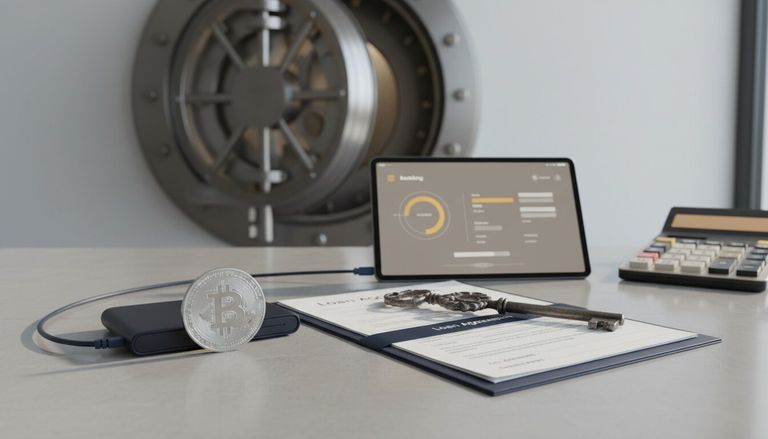
Borrowing against your bitcoin is generally not a taxable event. Loan proceeds are treated by the IRS as debt rather than income, so the cash that lands in your account when you take out a crypto-backed loan does not belong on your tax return. That is the short answer, and it is the one most articles stop at. That longer answer matters more. Liquidations, repayments made in crypto, and certain custody arrangements can all create reportable gains, sometimes large ones, and the paperwork trail changed significantly once brokers began filing Form 1099-DA with the IRS. Here is how the full life of a crypto loan looks through a tax lens, based on current IRS guidance as of July 2026.
Why borrowing against your crypto is usually tax-free
Behind this is a rule much older than bitcoin: money you borrow is not income, because you have an obligation to pay it back. Nothing about digital assets changes that principle. When you pledge 1 BTC and receive $30,000 in dollars or stablecoins, your net worth has not increased. You hold an asset and a matching liability.
Equally important is how the IRS classifies crypto. Under its digital asset guidance, digital assets are treated as property, not currency, and tax is triggered by a disposition, a sale, an exchange, a transfer of ownership, or payment made with the asset (irs.gov/filing/digital-assets). Pledging collateral while retaining ownership is none of those things. That same IRS page confirms that merely holding a digital asset, or buying one with dollars, creates no tax obligation.
There is one caveat worth stating plainly. The IRS virtual currency FAQ (irs.gov/individuals/international-taxpayers/frequently-asked-questions-on-virtual-currency-transactions) says that transferring crypto between wallets or accounts belonging to you is non-taxable, but it never addresses loan collateral directly. A standard collateralized loan, where you keep ownership along with the lender holds the coins in custody, fits comfortably within the non-taxable framework in the view of most practitioners. A platform that takes title to your coins, lends them out or promises to return "equivalent" assets rather than your assets sits on shakier ground. If your loan agreement reads that way, have a tax professional look at it before assuming the borrow was tax-free. If you want a refresher on how these structures differ, see our guide to how bitcoin loans work.
Every tax event in a crypto loan, from origination to payoff
Most competing explanations give you a yes or no and move on. An honest picture is a lifecycle, because a single loan can pass through half a dozen moments where tax either does or does not attach.
See also our article who pays taxes on a custodial account? the kiddie tax in.
See also our article what are the risks of crypto lending? 7 dangers us.
To go further, see our guide on crypto loan to buy a house in 2026 real costs and risks.
To go further, see our guide on crypto loan calculator: ltv, rates & liquidation math.
See also our article crypto loan without collateral: what's actually real in 2026.
| Loan stage | What happens | Taxable? | Why |
|---|---|---|---|
| Origination | You pledge BTC, receive USD or stablecoins | Generally no | Loan proceeds are debt, not income |
| Collateral transfer | BTC moves to the lender's custody wallet | Generally no (gray area) | Transfers between your own accounts are non-taxable per the IRS FAQ; no specific collateral guidance exists |
| Interest payments in USD | You pay interest in dollars | No gain event | Deductibility depends on use of proceeds |
| Interest paid in crypto | You pay interest with BTC or another coin | Yes | Spending crypto is a disposition of property |
| Margin call top-up | You add more BTC as collateral | No | No sale or exchange occurs |
| Partial or full liquidation | Lender sells your BTC to cover the loan | Yes | A sale of your property, reported by you |
| Repayment in crypto | You settle the loan balance with coins | Yes | Disposing of property to satisfy a debt |
| Return of collateral | Your BTC comes back to your wallet | No | Transfer back to your own account; original basis and holding period continue |
Two rows deserve emphasis. Liquidation is taxable to you even though you never clicked "sell," and repaying in crypto is taxable even though it feels like paying a bill. Both flow from the property classification. Any time coins leave your ownership for value, the IRS sees a disposition.
In brief
- Taking out a crypto-backed loan is generally not taxable; loan proceeds are debt, not income.
- A liquidation of your collateral is a sale of your property and must go on your return, even though the lender executed it.
- Repaying a loan in crypto or paying interest in crypto, is a disposition and can produce a gain or loss.
- Brokers now report digital asset sale proceeds to the IRS on Form 1099-DA, so unreported liquidations are easy to spot.
- Your cost basis and holding period stay with the coins through the loan; keep your own records because the lender often cannot report basis for you.
Liquidations: the tax bill nobody plans for
A liquidation happens when your collateral's value falls below the lender's threshold and the platform sells some or all of your coins to protect the loan. Mechanics are covered in our piece on margin calls and liquidation; here we care about what it does to your taxes.
Simple and unforgiving. The sale is yours. Your basis and holding period carry over, and the gain or loss goes on Form 8949.
A worked example
Suppose you bought 1 BTC for $40,000 in March 2024, including fees. Under the IRS FAQ, basis is the amount spent to acquire the asset, including fees, commissions, and other acquisition costs. In May 2026 you pledge that coin and borrow $30,000. The market drops, you miss a margin call, and the lender liquidates 0.6 BTC at $45,000 per coin, generating $27,000 in proceeds.
Your numbers:
- Proceeds: $27,000
- Basis of the 0.6 BTC sold: 0.6 × $40,000 = $24,000, capital gain: $3,000
You acquired the coins in March 2024 and they were sold in May 2026, so you held them for more than one year and the gain is long-term. Per IRS Tax Topic 409, for tax years beginning in 2025 the long-term capital gains rate is 0% for a single filer with taxable income at or below $48,350, 15% up to $533,400, and 20% above that (irs.gov/taxtopics/tc409). The 2026 thresholds adjust for inflation, so check the current figures when you file. A single filer in the 15% bracket would owe $450 on this liquidation.
Now change one fact: you bought the BTC in November 2025 instead. Held for one year or less, the $3,000 is a short-term gain taxed as ordinary income at your regular rates, which can be substantially higher. Holding period runs from the day after acquisition through the day of disposition. Note what did not matter in either version. Neither the loan balance nor who pulled the trigger changed the outcome. Liquidation timing follows the coins, not the loan.
One more wrinkle. Had the market fallen far enough that the liquidation proceeds were below your basis, you would realize a capital loss, which can offset other gains. A forced sale in a crash is painful, but failing to claim the loss makes it worse.
Deducting Crypto Loan Interest and Fees
Crypto loan interest gets less attention than it should. Three situations, three answers.
Interest paid in dollars on a loan used for personal spending is generally not deductible, the same as personal credit card interest. That covers most people borrowing against bitcoin to buy a car or cover living expenses.
Interest on proceeds used for investment or business purposes may be deductible under the regular investment interest or business interest rules. Those rules carry their own limitations and documentation requirements, and the deduction turns on tracing what the borrowed money actually funded. This is a genuine ask-your-CPA situation rather than a checkbox.
Interest or fees paid in crypto create a second, separate issue. Paying with coins is a disposition of property. If you pay a $500 fee using BTC that cost you $300 to acquire, you have a $200 gain to report on top of whatever the fee itself does or does not do for you. Platforms that auto-deduct fees from your collateral generate small dispositions all year, and each one belongs in your records.
How a crypto loan shows up on your tax return
Start with the question every federal filer now answers on Form 1040. Did you receive, sell, exchange, transfer, or otherwise dispose of a digital asset during the year? Simply holding coins, or pledging them along with borrowing against them, does not by itself force a "yes" under the IRS descriptions of what the question covers (irs.gov/filing/digital-assets). A liquidation or a crypto repayment does.
Dispositions go on Form 8949, which feeds Schedule D. Ordinary income from crypto, such as staking, mining, or airdrop rewards, goes on Schedule 1 or Schedule C, though that is usually outside the loan context.
On the lender's side, a bigger change has taken effect. Under the final broker reporting regulations, brokers must report gross proceeds on Form 1099-DA for digital asset sales effected on or after January 1, 2025, along with must report basis for certain covered assets starting with 2026 transactions (irs.gov/forms-pubs/about-form-1099-da). Here is the detail that matters for borrowers. Coins you transfer into a platform, which is exactly what happens when you post collateral, are generally treated as noncovered, so the broker does not have to report your basis even after 2025. The IRS may receive a form showing that 0.6 BTC was sold for $27,000 with no cost information attached. If you do not report the sale with your correct basis, the mismatch is now visible on the government's side of the ledger. Days when a liquidation could quietly go unreported ended with the 2025 filing season.
The common mistake: losing track of your cost basis
Most often, this is not a misreading of the law. It is a recordkeeping failure with two variants.
One common variant is assuming the liquidation was not reportable at all, on the theory that "the lender sold it, not me." As covered above, the sale is attributed to you, and the lender is likely telling the IRS about it. Skipping it invites an automated notice.
Another variant is subtler. Borrowers who correctly report the liquidation often cannot substantiate their basis. The coins may have been bought years earlier across two exchanges and a hardware wallet, transferred into the loan platform, along with sold in slices across several margin events. Without records, some taxpayers end up defaulting to a basis of zero, which taxes the entire proceeds instead of just the gain. On the worked example above, reporting zero basis would mean paying tax on $27,000 rather than $3,000.
Boring and effective, the fix starts with a simple recordkeeping habit. Before you pledge coins, write down the acquisition date, the total cost including fees, along with the wallet trail for each lot. Keep the loan agreement and every liquidation confirmation the platform sends. If the platform issues a 1099-DA, reconcile it against your own records rather than copying it blindly, since a proceeds-only form tells half the story. And because crypto lending sits in an area where formal IRS guidance is still thin, have a CPA or Enrolled Agent review anything beyond a plain-vanilla loan, including crypto-denominated interest, rehypothecation clauses, a collateral top-up paid in crypto, or a liquidation that spans two tax years.
Sources
- IRS, Digital assets: https://www.irs.gov/filing/digital-assets
- IRS, Frequently asked questions on virtual currency transactions: https://www.irs.gov/individuals/international-taxpayers/frequently-asked-questions-on-virtual-currency-transactions
- IRS, Topic No. 409, Capital gains and losses: https://www.irs.gov/taxtopics/tc409
- IRS, About Form 1099-DA, Digital Asset Proceeds From Broker Transactions: https://www.irs.gov/forms-pubs/about-form-1099-da
Quick facts
| Borrowing against crypto | Generally not taxable; loan proceeds are debt, not income |
| IRS classification | Digital assets are property, not currency |
| Collateral liquidation | Taxable sale attributed to you, even if the lender executes it |
| Repaying in crypto | Taxable disposition of property |
| Long-term rates (2025 tax year) | 0%, 15%, or 20% depending on taxable income (IRS Topic 409) |
| Short-term gains | Taxed as ordinary income; holding period of one year or less |
| Key forms | Form 8949, Schedule D, Form 1099-DA |
| Broker reporting | Gross proceeds reported from 2025; basis for covered assets from 2026 |
| Transferred-in collateral | Usually noncovered: broker may not report your basis, so keep records |
The information provided here is general in nature and is not a substitute for advice from a licensed financial advisor. Review your situation with a professional before committing.
Frequently asked questions
Is taking out a bitcoin loan a taxable event?
Generally no. Loan proceeds are debt, not income, so borrowing dollars against bitcoin you continue to own does not by itself trigger tax. The IRS treats digital assets as property, and no disposition occurs when you pledge collateral and receive a loan. Tax enters the picture if your collateral is sold, if you repay the loan in crypto, or if the arrangement is structured so that you actually give up ownership of the coins.
What happens tax-wise if my collateral is liquidated?
A liquidation is a sale of your property, even though the lender executes it. You must report the disposition on Form 8949 and Schedule D, using the fair market value received as proceeds and your original purchase cost as basis. Whether the gain is short-term or long-term depends on how long you held the coins before the liquidation, not on how long the loan was open.
Do crypto lenders send tax forms to the IRS?
Increasingly, yes. Under the final broker reporting regulations, brokers report gross proceeds on Form 1099-DA for transactions from January 1, 2025 onward, and basis reporting applies to certain covered assets from 2026. Coins you transfer into a platform are generally treated as noncovered, meaning the form may show what the sale brought in but not what you paid, so your own records still determine your gain.
Can I deduct the interest on a crypto-backed loan?
It depends entirely on what the borrowed money was used for. Interest on funds used for personal spending is generally not deductible. If the proceeds were used for investment or business purposes, a deduction may be available under the usual investment or business interest rules, which have their own limits. This is one of the areas where a CPA or Enrolled Agent earns their fee, because the use-of-proceeds test is fact specific.
Does moving my BTC to the lender's custody wallet count as a sale?
The IRS has not published guidance specific to loan collateral. Its virtual currency FAQ does say that transferring crypto between wallets or accounts belonging to you is a non-taxable event. Most practitioners treat a standard collateral transfer the same way when you retain ownership and the right to get the same asset back. Arrangements where the platform takes title to your coins or rehypothecates them are murkier, and worth a professional review before you sign.
Keep reading

Who Claims Income on a Custodial Account? (2026 Rules
The child owns the income on a custodial account, but the kiddie tax may push the bill to the parent's rate. Here's exactly how reporting works in 2026.
By Evan Patel · August 9, 2026

Custodial Account Taxes 2026: Kiddie Tax Rules & the $2,700
Do you have to pay taxes on custodial accounts? Yes, here's how the IRS kiddie tax works in 2026, who files, and the $2,700 threshold that triggers the
By Evan Patel · August 8, 2026